
Demand Gen vs Paid Social, Where Google’s Visual Inventory Now Fits in the Funnel Angle: Compare Demand Gen, YouTube Shorts, and Meta-style discovery campaigns for modern acquisition. Good for readers choosing budget splits.


Where Demand Gen, YouTube Shorts, and Meta discovery campaigns fit in your acquisition funnel.
Platform Positioning
YouTube Shorts excels at mass awareness with 200B daily views. Meta discovery drives consideration with precise interest targeting. Demand Gen captures in-market audiences across Google's visual inventory.Strategic Allocation
Launch-stage businesses allocate 50% to Shorts for awareness. Mature brands shift 40% to Demand Gen for efficient acquisition. Meta maintains 30-45% across all stages for consideration.Budget Requirements
Demand Gen requires $100+ daily for optimal performance despite $5 minimum. Last-click attribution systematically undervalues discovery campaigns-use 7-day click and 28-day view windows minimum.
Visual discovery advertising has fundamentally changed how performance marketers allocate budgets. I've spent years testing these platforms, and the data shows that most businesses misallocate spend by treating all visual channels identically. Here's how to match each platform's strengths to your funnel stage and audience maturity.
Understanding Demand Generation Campaigns: Google’s Visual-First Approach
Google’s Demand Generation campaigns represent a fundamental shift in how advertisers reach potential customers across visual platforms. Launched around 2022 as a discovery-focused product, Demand Gen reaches shoppers across YouTube, Discover, Gmail, Google Network, Maps, and other placements. Unlike traditional search campaigns that target active intent, Demand Gen focuses on creating awareness and interest among audiences who aren’t yet actively searching for your products.
The platform utilises AI-powered targeting to identify users based on their interests, behaviours, and consumption patterns across Google’s ecosystem. You can reach audiences through immersive video content, swipeable image carousels, and native-looking placements that blend seamlessly into the user experience. This positions Demand Gen as a discovery tool rather than a conversion-focused channel, making it particularly effective for brands looking to expand their reach beyond bottom-funnel tactics.
According to Google’s official blog, on average, 68% of Demand Gen conversions came from users who did not see the brand’s Search ads in the prior 30 days, demonstrating its effectiveness at reaching genuinely new audiences.
Core Placement Inventory and Visual Formats
Demand Gen campaigns appear across three primary surfaces. YouTube serves as the flagship placement, including in-feed positions, Shorts, and in-stream inventory. The Discover feed-Google’s personalised content stream accessed by over 800 million monthly users-provides native article-style placements. Gmail rounds out the inventory with interactive ads in the Promotions and Social tabs.
The visual formats available include single images, carousel ads (up to 10 swipeable cards), and video assets up to 60 seconds. Google automatically optimises creative combinations, testing different headlines, descriptions, and visual elements to identify top performers. This automated approach reduces manual testing burden whilst maximising engagement across placements.
Google reports that creator partnership campaigns on YouTube Shorts delivered an average 30% uplift in conversions while maintaining CPA efficiency, based on data from January 2025 to January 2026, according to Google’s March 2026 Demand Gen Drop.
Targeting Capabilities and Audience Signals
Demand Gen offers sophisticated audience targeting through multiple signal types. You can leverage custom segments built from website visitors, customer lists, or YouTube engagement data. Lookalike audiences (similar segments in Google’s terminology) expand reach to users who share characteristics with your best customers.
Interest-based targeting taps into Google’s understanding of user affinities across multiple categories. Life event targeting captures users during significant moments like moving house, changing jobs, or planning weddings. The platform also supports demographic targeting and detailed audience exclusions to refine reach.
Demand Gen’s AI targeting analyses signals to identify users most likely to engage with your creative, making it particularly powerful for cold audience acquisition.
Important budget consideration: Starting on April 1st, 2026, Google will begin enforcing a minimum daily budget of $5 USD, or the equivalent in local currency, for all Demand Gen campaigns, as announced on the Google Ads Developer Blog. However, Google recommends a minimum of $100 per day for Demand Gen campaigns, or 20x your target CPA-so if your target CPA is $10, that’s $200 per day minimum for optimal performance, according to Store Growers’ comprehensive guide.
Meta’s Discovery Advertising Ecosystem: Feed, Stories, and Reels
Meta’s advertising platforms-Facebook and Instagram-have evolved into a comprehensive discovery engine that reaches users across multiple touchpoints throughout their daily scrolling behaviour. Unlike Google’s intent-based search heritage, Meta built its advertising foundation on interest-based targeting and social discovery, making it inherently suited for top-of-funnel awareness campaigns.
The platform’s strength lies in its granular understanding of user behaviour, interests, and social connections. As of Q1 2025, Meta’s Family of Apps averaged 3.43 billion daily active users across Facebook, Instagram, WhatsApp, and Messenger, meaning you can reach nearly half the global population through a single ad ecosystem, according to inBeat Agency’s Meta statistics report.
Budget Requirements
Google recommends $100+ daily or 20x target CPA for optimal performance
Placement Diversity Across the Meta Family
Meta’s advertising inventory spans multiple surfaces within its app ecosystem. Facebook Feed and Instagram Feed remain core placements, delivering ads between organic posts in a native format. Stories-the vertical, full-screen format-appears across both platforms with immersive creative that captures undivided attention for several seconds.
Reels has emerged as Meta’s answer to short-form video dominance, competing directly with TikTok and YouTube Shorts. As of January 2025, Instagram has officially extended the maximum Reels length to 3 minutes (180 seconds), doubling the previous 90-second limit, marking a significant evolution in the platform’s approach to short-form video content, as reported by NearStream. The Explore page on Instagram provides additional discovery inventory, reaching users actively browsing new content.
Right-column desktop ads, Marketplace placements, and in-stream video ads round out the inventory. Meta’s Advantage+ placements automatically distribute ads across all available surfaces for optimal performance, using AI to identify where each creative piece performs best, according to Straight North’s Meta advertising guide.
Targeting Precision Through Social Signals
Meta’s targeting capabilities remain among the most sophisticated in digital advertising, despite privacy changes from iOS 14.5 onwards. Core Audiences allow targeting by demographics, interests (thousands of categories), behaviours, and connections. You can layer multiple criteria to build highly specific segments-for example, “women aged 25-34 interested in sustainable fashion who recently engaged with eco-friendly content.”
Custom Audiences enable retargeting of website visitors, app users, customer lists, and engagement audiences (users who interacted with your Facebook or Instagram content). Lookalike Audiences expand reach by identifying users similar to your best customers, available in percentile ranges from 1% (most similar) to 10% (broader reach).
Meta’s Advantage+ audience targeting uses machine learning to expand beyond your defined parameters, automatically finding additional users likely to convert. This automated approach often outperforms manual targeting, particularly for conversion-focused campaigns, though it reduces advertiser control over precise audience composition.
Creative Formats Optimised for Discovery
Meta offers diverse creative formats tailored to different campaign objectives. Single image ads work across all placements with recommended aspect ratios of 1:1 (square) or 4:5 (vertical). Carousel ads allow up to 10 swipeable cards, ideal for showcasing product catalogues or telling sequential stories.
Video ads support various lengths, from 6-second bumper-style clips to longer-form content up to 241 minutes (though practical performance favours brevity). Collection ads combine video or images with product catalogues, creating an immersive shopping experience without leaving the platform.
Meta’s algorithm favours authentic, native-looking creative over polished advertising content-user-generated style videos and behind-the-scenes content often outperform studio-quality production.
YouTube Shorts: The Vertical Video Disruptor in Google’s Arsenal
YouTube Shorts has rapidly evolved from a TikTok competitor into a critical component of Google’s advertising ecosystem. Launched globally in July 2021, Shorts delivers vertical videos up to 60 seconds, designed for mobile-first consumption. YouTube hits 2.85 billion users and 200 billion daily Shorts views in 2026, according to Affinco’s YouTube statistics report, making it impossible for performance marketers to ignore.
Shorts advertising operates within two primary frameworks: dedicated Shorts campaigns (available in select markets) and Shorts placements within broader video campaigns. When included in Demand Gen campaigns, Shorts inventory receives automated budget allocation alongside other YouTube and Discovery placements. This integration allows advertisers to capture attention across both traditional YouTube content and the high-engagement Shorts environment.

Engagement Patterns and User Behaviour
Shorts users exhibit distinct consumption patterns compared to traditional YouTube viewers. The average Shorts session involves rapid-fire scrolling through dozens of videos, with users making engagement decisions within 1-3 seconds. This creates both opportunity and challenge-you can reach massive audiences quickly, but creative must hook attention immediately.
YouTube Shorts has 2 billion monthly users, ahead of TikTok (1.59B) and Instagram Reels (1.8B), and Shorts leads all short-form platforms in engagement with a 5.91% rate, as reported by Loopex Digital.
The format favours authentic, unpolished content over traditional advertising aesthetics. Top-performing Shorts ads often mimic organic creator content, using trending audio, text overlays, and jump cuts. Users expect entertainment value first, with commercial messaging woven subtly into the narrative rather than leading with product features.
Shorts-Specific Creative Requirements
Effective Shorts creative adheres to specific technical and stylistic parameters. The vertical 9:16 aspect ratio is mandatory, optimised for full-screen mobile viewing. Videos should be 15-60 seconds, though performance data suggests 15-30 seconds drives strongest completion rates.
Hook viewers within the first 1-2 seconds using movement, bold text, or pattern interrupts. Front-load key messages since many users scroll before completion. Include captions or text overlays-many users watch without sound. End with clear calls-to-action, though avoid hard-selling approaches that feel discordant with the entertainment-focused environment.
Shorts creative that performs well organically-high view-through rates, shares, and comments-typically outperforms traditional video ads when promoted, making creator partnerships particularly valuable.
Comparative Performance Metrics: Where Each Platform Excels
Understanding where Demand Gen, Meta discovery campaigns, and YouTube Shorts deliver optimal results requires examining performance across multiple dimensions. Each platform demonstrates distinct strengths depending on campaign objectives, audience characteristics, and creative approach.
Cost Efficiency and CPM Benchmarks
Cost per thousand impressions (CPM) varies significantly across platforms and evolves with auction dynamics. The median CPA across all industries landed at $38.17, and CPM sat at $13.48 for Meta in 2025, reflecting the premium brands pay to reach audiences inside a crowded auction environment, according to Triple Whale’s Facebook Ads benchmarks.
Average CPMs in 2026 vary by platform: TikTok $4 à 8, X $5 à 10, Meta $8 à 14, YouTube $10 à 18, and LinkedIn $20 à 45, as reported in The Jonas Agency’s 2026 paid media benchmarks.
Google Demand Gen campaigns generally show varied CPM performance across YouTube, Discover, and Gmail placements. YouTube Shorts specifically can deliver cost-competitive impressions when targeting broad audiences, making it attractive for awareness objectives. However, more refined targeting or competitive verticals push costs higher.
| Platform | Typical Use Case | Best For | Audience Scale |
|---|---|---|---|
| Meta Feed | Detailed interest targeting | Consideration campaigns | Very High |
| Meta Reels | Broad awareness, younger demos | Discovery and engagement | High |
| Demand Gen (All) | Visual storytelling, consideration | Multi-surface reach | High |
| YouTube Shorts | Mass awareness, viral potential | Top-of-funnel discovery | Very High |
Engagement Rates and Interaction Quality
Engagement metrics reveal how users interact with creative across platforms. Meta Reels typically achieve engagement rates ranging from approximately 3-8% for well-crafted content depending on account size and content quality, significantly higher than Feed placements. This elevated engagement reflects the immersive, full-screen format and entertainment-focused user mindset.
YouTube Shorts engagement varies widely based on creative quality and targeting precision. View-through rates and retention metrics are critical for Shorts performance, with top-performing content achieving strong completion rates. However, click-through rates to external destinations remain lower than traditional YouTube formats, as users prefer staying within the Shorts feed.
Demand Gen campaigns across all placements show click-through rates that vary based on creative strength and offer relevance. Gmail placements often deliver higher CTRs when targeting engaged audiences, whilst Discover placements perform better for visual storytelling with lower immediate conversion intent.
Conversion Attribution and Funnel Position
Each platform occupies different positions in the customer journey, affecting conversion attribution. Meta’s discovery campaigns excel at driving website actions when targeting warm audiences (retargeting, lookalikes), often achieving solid conversion rates for e-commerce. However, cold audience conversion rates typically fall lower, positioning Meta discovery as a mid-to-top funnel tool.
Demand Gen campaigns generally require longer attribution windows to demonstrate value. Immediate conversion rates often appear lower than bottom-funnel search campaigns, but assisted conversions and view-through conversions reveal significant influence on later purchase decisions. Attribution models show Demand Gen typically contributes meaningfully to total conversion value when users interact with multiple touchpoints.
YouTube Shorts, as a relatively newer advertising format, shows the longest path to conversion for most businesses. Direct conversion rates tend to be modest, but brand lift studies demonstrate significant increases in search volume and branded queries following Shorts campaigns. This positions Shorts as a pure awareness play, with conversion impact materialising through other channels.
Successful performance marketers allocate substantial portions of visual discovery budgets to platforms demonstrating strong assisted conversion metrics, not just last-click attribution, recognising the multi-touch nature of modern customer journeys.
Strategic Budget Allocation Framework for Multi-Platform Discovery
Determining optimal budget distribution across Demand Gen, Meta discovery, and YouTube Shorts requires a systematic approach based on business objectives, audience characteristics, and funnel stage priorities. Rather than spreading budgets evenly, strategic allocation concentrates spend where each platform’s unique strengths align with specific campaign goals.
Market concentration context: Alphabet, Amazon and Meta take a combined market share of 56.1% excluding China in 2025-equivalent to $556.6bn-rising to 58.0% in 2026, according to WARC’s Global Ad Forecast. This concentration reflects where most digital advertising budgets flow globally.
- YouTube Shorts 50%
- Meta Discovery 30%
- Demand Gen 20%
- Mass awareness focus
- YouTube Shorts 20%
- Meta Discovery 40%
- Demand Gen 40%
- Efficient acquisition
Audience Maturity and Platform Selection
Your audience’s familiarity with your brand fundamentally influences platform prioritisation. For completely cold audiences with zero brand awareness, YouTube Shorts offers cost-effective reach at scale. Consider allocating significant discovery budget to Shorts when launching new products or entering new markets, leveraging competitive CPMs to build initial awareness rapidly.
Meta discovery campaigns (Feed, Stories, Reels) perform optimally with warm audiences-users who’ve shown interest in your category but haven’t yet engaged with your brand specifically. Interest-based targeting and lookalike audiences make Meta ideal for the consideration phase. Allocate substantial budget here when you’ve established baseline awareness and need to deepen engagement.
Demand Gen campaigns across YouTube, Discover, and Gmail excel when targeting audiences demonstrating intent signals-users who’ve visited competitor websites, searched related terms, or engaged with category content. Reserve meaningful budget for Demand Gen when you’re capturing in-market audiences ready to evaluate options.
Funnel Stage Budget Distribution Model
A balanced discovery campaign strategy allocates budget across funnel stages, recognising that each platform serves different roles. The following framework provides a starting point for businesses running comprehensive visual discovery programmes:
Top of Funnel (Awareness) – Substantial Portion of Total Discovery Budget:
- YouTube Shorts: Major allocation
- Meta Reels: Supporting allocation
- Demand Gen (broad targeting): Supplementary allocation
Middle of Funnel (Consideration) – Significant Portion of Total Discovery Budget:
- Meta Feed/Stories (interest targeting): Primary allocation
- Demand Gen (affinity audiences): Supporting allocation
Lower-Middle Funnel (Evaluation) – Meaningful Portion of Total Discovery Budget:
- Demand Gen (in-market audiences): Primary allocation
- Meta (lookalike audiences): Supporting allocation
This distribution assumes a business prioritising new customer acquisition. Adjust ratios based on your specific growth stage-early-stage businesses may allocate more heavily to pure awareness, whilst established brands might shift more budget to consideration and evaluation stages.
Seasonal and Campaign-Specific Adjustments
Budget allocation should flex based on campaign timing and objectives. During peak seasons (Christmas, Black Friday, industry-specific events), consider increasing Meta’s share due to its conversion capabilities with time-sensitive offers. The platform’s direct response heritage makes it more effective for promotional campaigns with clear CTAs.
For brand launches or major announcements, shift substantial budget to YouTube Shorts and Demand Gen video placements for several weeks, prioritising reach and frequency over immediate conversions. These platforms excel at storytelling and building anticipation through immersive creative formats.
When launching in new geographic markets, front-load budget to YouTube Shorts initially to establish baseline awareness cost-effectively, then transition to Meta and Demand Gen as brand recognition grows.
Testing Budget and Incremental Scaling
Reserve a portion of total discovery budget for structured testing across platforms. Run controlled experiments comparing identical creative across Demand Gen, Meta Reels, and YouTube Shorts to identify which platform delivers superior engagement and conversion metrics for your specific audience.
Scale winning platforms incrementally-increase budget gradually rather than doubling overnight. Rapid scaling often degrades performance as algorithms expand beyond core audiences. Monitor efficiency metrics (CPM, CTR, CPA) daily during scaling periods, pulling back when costs increase beyond acceptable thresholds.
| Business Stage | YouTube Shorts | Meta Discovery | Demand Gen | Primary Objective |
|---|---|---|---|---|
| Launch (0-3 months) | 50% | 30% | 20% | Mass awareness |
| Growth (3-12 months) | 30% | 45% | 25% | Consideration + conversion |
| Mature (12+ months) | 20% | 40% | 40% | Efficient acquisition |
| Seasonal promotion | 15% | 55% | 30% | Direct response |
Creative Strategy Optimisation Across Visual Platforms
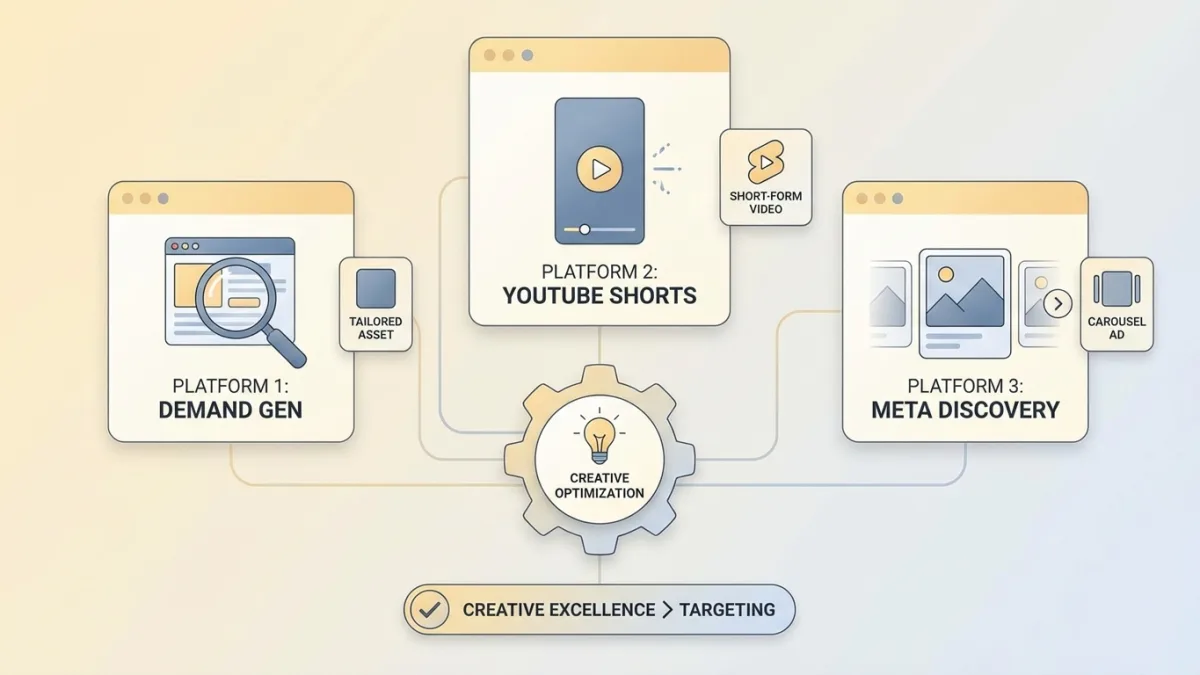
Creative excellence determines success across all visual discovery platforms, often mattering more than targeting precision or budget size. Each platform rewards specific creative approaches, requiring tailored asset production rather than one-size-fits-all repurposing. Understanding these nuances separates high-performing campaigns from mediocre ones.
Platform-Specific Creative Best Practices
YouTube Shorts creative should prioritise entertainment value and rapid hooks. Open with movement, unexpected visuals, or bold text within the first second to stop scrolling behaviour. Structure content using the “hook-value-CTA” framework: grab attention immediately, deliver useful or entertaining content, close with a soft call-to-action. Avoid overt sales messaging-Shorts users resist traditional advertising and respond better to native, creator-style content.
Concept Testing
Test 3-5 creative approaches for 7-10 days
Identify Winners
Analyze engagement metrics and CTR
Variation Testing
Test individual elements for 5-7 days
Continuous Refresh
Replace underperformers, combat fatigue
Meta discovery creative performs best when mimicking organic posts rather than polished advertisements. User-generated content (UGC) style videos-filmed on smartphones with authentic testimonials-consistently outperform studio-produced assets. For Feed and Stories, use bold captions and text overlays since many users browse with sound off. Reels should leverage trending audio and effects to appear native to the platform.
Demand Gen campaigns across YouTube, Discover, and Gmail benefit from higher production quality than Shorts or Reels. These placements suit brand storytelling, product demonstrations, and lifestyle imagery that builds aspiration. Use the carousel format to showcase multiple products or tell sequential stories. Gmail ads can include more detailed copy since users are in a browsing rather than rapid-scrolling mindset.
Testing Frameworks for Creative Iteration
Implement structured creative testing to identify top performers systematically. Start with concept testing-develop 3-5 distinct creative approaches (different hooks, messaging angles, visual styles) and run each with equal budget for 7-10 days. Analyse engagement metrics (CTR, view-through rate, engagement rate) to identify winning concepts.
Once you’ve identified strong concepts, test variations within that theme. Change individual elements-headline, opening shot, CTA, background music-whilst keeping other variables constant. This isolates which specific components drive performance improvements. Run these variation tests for 5-7 days with sufficient budget to achieve statistical significance.
Top-performing advertisers refresh creative regularly to combat ad fatigue, particularly on Meta where audiences see the same ads repeatedly. Maintain a pipeline of multiple creative assets in various testing stages to ensure continuous optimisation.
Asset Production Efficiency and Repurposing
Efficient creative production maximises output without compromising quality. Film multiple creative concepts in single production sessions-shoot 5-7 different hooks, messages, and scenarios in one day to build a content library. This batching approach reduces per-asset costs whilst providing testing inventory.
Repurpose strategically across platforms by adapting core concepts rather than using identical assets. A 30-second Demand Gen video can be edited into multiple shorter Shorts clips, each highlighting different product benefits. Meta carousel ads can be transformed into YouTube video sequences. This approach maintains creative consistency whilst respecting platform-specific best practices.
Leverage creator partnerships and UGC to scale production cost-effectively. Provide product to micro-influencers in exchange for usage rights to their content. This generates authentic creative at fraction of traditional production costs, whilst delivering the native aesthetic that performs well across discovery platforms.
Dynamic Creative and Automated Optimisation
Both Google and Meta offer dynamic creative capabilities that automatically test combinations of headlines, descriptions, images, and videos. Feed these systems with diverse assets-multiple headlines, description variants, and numerous images or videos-to enable thorough testing.
Monitor asset-level reporting to identify top performers. Google’s Demand Gen asset report shows performance by individual creative element, revealing which headlines and images drive strongest engagement. Meta’s breakdown tools provide similar insights across placements and creative components.
Replace underperforming assets aggressively. If an image or video shows CTR below campaign average after sufficient impressions, swap it for new creative. Retain top performers but introduce fresh variations to combat fatigue-even winning creative degrades after several weeks of continuous exposure to the same audiences.
Measurement, Attribution, and Performance Analysis
Accurate measurement across visual discovery platforms requires sophisticated attribution models and cross-platform analysis. Single-touch attribution models-crediting only the last click before conversion-systematically undervalue discovery campaigns, which primarily influence earlier funnel stages. Implementing multi-touch attribution reveals true platform contribution to business outcomes.
Attribution Models for Discovery Campaigns
Data-driven attribution (DDA) distributes conversion credit across multiple touchpoints based on their actual influence on conversion probability. Google Analytics 4 and Google Ads both offer DDA models that analyse conversion paths to assign proportional credit. This typically reveals Demand Gen campaigns contributing more conversion value than last-click models suggest.
Attribution Best Practices
5 essentials- 1 Use data-driven attribution models
- 2 Implement 7-day click, 28-day view windows
- 3 Track view-through conversions for video
- 4 Run incrementality tests for true impact
- 5 Calculate blended cross-platform metrics
Meta’s attribution tools allow comparison across 1-day, 7-day, and 28-day click and view windows. For discovery campaigns targeting cold audiences, 7-day click and 28-day view attribution more accurately captures delayed conversions. Users often see a Reels ad, research your brand later, then convert through search or direct traffic-attribution windows capture this behaviour.
Implement view-through conversion tracking for YouTube campaigns, particularly Shorts. Many users watch video ads without clicking, then search for your brand or visit directly. View-through conversions (conversions within 30 days of video view) often represent a substantial portion of total YouTube-influenced conversions, invisible in click-only tracking.
Cross-Platform Journey Analysis
Use Google Analytics 4’s path exploration reports to visualise how users interact with multiple platforms before converting. Common patterns show users discovering brands through YouTube Shorts or Meta Reels, researching via Google Search, then converting through direct traffic or retargeting ads. Understanding these patterns informs budget allocation and creative messaging across touchpoints.
Implement UTM parameters consistently across all platforms to track source/medium accurately. Use campaign-specific UTMs that identify not just the platform but the campaign type and creative variant. This granular tracking enables comparison of Demand Gen versus Meta discovery performance within your analytics platform rather than relying solely on platform-reported metrics.
Survey new customers about discovery sources to supplement digital tracking. Post-purchase surveys asking “How did you first hear about us?” often reveal discovery touchpoints that attribution models miss, particularly for longer consideration cycles or offline conversions.
Key Performance Indicators by Campaign Objective
Different discovery campaigns require different success metrics aligned with funnel position. Awareness campaigns prioritise reach metrics-impressions, unique users reached, video view-through rate, and brand lift. Demand Gen and Shorts campaigns targeting cold audiences should be evaluated on cost per thousand reached (CPM) and engagement rate rather than immediate conversions.
Consideration campaigns focus on engagement metrics-click-through rate, landing page engagement (time on site, pages per session), and assisted conversions. Meta discovery campaigns targeting interest audiences and Demand Gen campaigns with affinity targeting should demonstrate strong engagement even if direct conversions remain modest.
Lower-funnel discovery campaigns (lookalike audiences, in-market targeting) warrant evaluation on conversion metrics-cost per acquisition, return on ad spend, and conversion rate. These campaigns target users closer to purchase decisions and should demonstrate clearer ROI, though still typically lower than bottom-funnel search campaigns.
| Metric | Awareness Campaigns | Consideration Campaigns | Conversion Campaigns |
|---|---|---|---|
| Primary KPI | CPM, Reach | Engagement Rate, CTR | CPA, ROAS |
| Secondary KPI | View-Through Rate | Time on Site | Conversion Rate |
| Success Threshold | Competitive CPM | CTR > 1.5% | ROAS > 2.5x |
| Attribution Window | 28-day view | 7-day click | 1-day click |
Incrementality Testing and True Impact
Run incrementality tests to measure true platform impact beyond attribution models. Geo-holdout tests pause campaigns in specific regions whilst continuing in others, comparing conversion rates between test and control markets. This reveals whether discovery campaigns generate new demand or simply capture existing intent.
Brand lift studies measure awareness, consideration, and purchase intent changes among exposed versus unexposed audiences. Google and Meta both offer brand lift measurement for qualifying campaigns, providing scientific validation of upper-funnel impact that conversion tracking alone cannot demonstrate.
Calculate blended metrics across all discovery platforms to assess overall programme performance rather than optimising individual platforms in isolation. A holistic view often reveals that platforms working together generate superior results than any single platform optimised independently-the synergy of multi-platform presence compounds brand recognition and trust.
Frequently Asked Questions
Demand Gen is Google’s top-of-funnel campaign type that puts your products in front of people who aren’t searching for them yet, across YouTube, Discover, Gmail, and other placements. It represents Google’s latest push into the middle and top funnel of advertising. At its core, Demand Gen is an AI-powered campaign type designed to reach people before they start searching for your product or service-while Search campaigns capture existing intent, Demand Gen creates it.
Advertisers can use creator partnerships to turn authentic creator content into high-performing assets on Shorts and in-stream, using YouTube’s AI-powered ad solutions like Demand Gen, Video Reach, and Video View campaigns to meet their marketing objectives. Demand Gen campaigns prioritise action-oriented placements for sales and leads, and are specifically engineered to turn passive scrolling into measurable site visits.
Whether $20 daily is sufficient depends on your industry, competition, and conversion goals rather than being universally good or bad. Google enforces a minimum daily budget of $5 USD for all Demand Gen campaigns starting April 1, 2026, but recommends $100+ daily for optimal performance. Budgets aren’t one-size-fits-all-what you should spend depends on your goals, margins, and funnel efficiency. For most businesses, testing with $20 daily can provide initial data, but scaling requires budget alignment with your customer acquisition cost and lifetime value.
Amazon, Meta, and Alphabet (Google) dominate global digital advertising. According to WARC’s research, these three platforms account for 56.1% of global advertising investment outside China in 2025, and 58.0% in 2026. The concentration continues to grow as digital platforms deepen their grip on global ad budgets, with Amazon emerging as the primary beneficiary within this triopoly.
Google’s data revealed that 68% of Demand Gen conversions come from users who hadn’t seen the brand’s Search ads in the prior 30 days, meaning Demand Gen is genuinely reaching new audiences you wouldn’t capture through Search or Performance Max alone. Meta excels at behavioural targeting and retargeting, while Demand Gen focuses on creating intent across Google’s visual inventory. Both platforms serve complementary roles in a full-funnel strategy.
Optimal budget allocation varies by business stage and objectives. For a brand spending $10,000/month across digital advertising platforms, a starting allocation might look like Search at 40%, Paid Social (Meta) at 30%, Video (YouTube or CTV) at 15%, and secondary channels at 10%. However, optimal budget allocation isn’t static-it shifts based on competitive dynamics, seasonal trends, audience behaviour, and performance across all your active campaigns. Test systematically and let data guide your allocation decisions.
YouTube Shorts is experiencing explosive growth with more than 2 billion people watching Shorts every month, racking up over 200 billion views per day as of 2026. Shorts excel at top-of-funnel awareness and consideration, bridging social culture with advertising performance. In-feed ads in Shorts are integrated into the vertical experience, almost indistinguishable from organic content. Demand Gen Campaigns combine Shorts with Discover, Gmail and the YouTube feed to maximise reach and performance.